
Introduction: Sony A7 V vs Canon R6 Mark II
The Sony A7 V vs Canon R6 Mark II comparison is especially interesting because both cameras target photographers and creators who want one full-frame body capable of serious still photography and high-quality video.
However, they approach that goal differently. Sony’s newer Alpha 7 V uses a 33MP partially stacked full-frame sensor, a BIONZ XR2 processor with integrated AI-based subject-recognition capabilities, blackout-free electronic shooting up to 30fps, and advanced video options including cropped 4K120.
Canon’s EOS R6 Mark II uses a 24.2MP full-frame sensor and DIGIC X processor while offering an even higher 40fps maximum electronic burst and full-width oversampled 4K60 recording.
There is also a meaningful price difference. Sony positions the Alpha 7 V as a premium hybrid body, while the Canon R6 Mark II can often be found for noticeably less. Since Amazon pricing can change frequently, buyers should always check the current listing before ordering.
This comparison focuses on what those differences mean in real purchasing terms—not simply which camera has the longest specification sheet.
Check Sony A7 V Price on Amazon
Check Canon R6 Mark II Price on Amazon

Sony A7 V vs Canon R6 Mark II: Quick Verdict
| Award | Winner | Why |
|---|---|---|
| Best Overall | Sony Alpha 7 V | Higher resolution, newer sensor architecture, sophisticated AF, stronger connectivity and hybrid tools |
| Best Value | Canon EOS R6 Mark II | Excellent speed and video capabilities for substantially less |
| Best for Beginners | Canon EOS R6 Mark II | More approachable handling and excellent subject detection |
| Best for Professionals | Sony Alpha 7 V | Strong combination of resolution, workflow options, connectivity and hybrid performance |
| Best Premium Choice | Sony Alpha 7 V | Newer technology and broader advanced shooting features |
Neither is really an entry-level camera. Here, “best for beginners” means the easier option for someone moving into an advanced full-frame system, not the cheapest camera for learning photography.
The Sony is the more advanced all-rounder, while the Canon remains one of the most compelling choices for buyers who prioritize performance per dollar.
Sony A7 V vs Canon R6 Mark II Specifications Comparison
| Specification | Sony Alpha 7 V | Canon EOS R6 Mark II |
| Model | ILCE-7M5 | EOS R6 Mark II / 5666C002 |
| Camera Type | Full-frame mirrorless | Full-frame mirrorless |
| Sensor | 33MP partially stacked Exmor RS CMOS | 24.2MP full-frame CMOS |
| Processor | BIONZ XR2 with integrated AI processing | DIGIC X |
| Lens Mount | Sony E-mount | Canon RF mount |
| Maximum Electronic Burst | Up to 30fps | Up to 40fps |
| Mechanical Burst | Up to 10fps | Up to 12fps |
| Autofocus | Up to 759 phase-detection points | Dual Pixel CMOS AF II |
| Subject Recognition | Humans, animals, birds, insects, cars, trains and aircraft | People, animals and vehicles |
| Image Stabilization | 5-axis IBIS | In-body image stabilization |
| Maximum 4K Video | Up to 4K120 | Up to 4K60 |
| 4K120 | Yes, with APS-C/Super 35 crop | No |
| 4K60 | Yes | Yes, full-width oversampled |
| EVF | Approx. 3.69M dots | Approx. 3.69M dots |
| Rear Display | 3.2-inch, approx. 2.1M dots | 3.0-inch, approx. 1.62M dots |
| Storage | CFexpress Type A/UHS-II SD + UHS-II SD | Dual UHS-II SD |
| Battery | NP-FZ100 | LP-E6-series |
| HDMI | Full-size Type-A HDMI | Micro HDMI |
| USB | Dual USB-C | USB-C |
| Microphone Input | Yes | Yes |
| Headphone Output | Yes | Yes |
| Wireless | Newer Wi-Fi and Bluetooth connectivity | Wi-Fi and Bluetooth |
| Ready-to-Shoot Weight | Approx. 695g | Approx. 670g |
| Built-in Storage | Not applicable | Not applicable |
| GPU / RAM | Not published as PC-style specifications | Not published as PC-style specifications |
| Color | Black | Black |
The comparison table includes only camera specifications that are relevant and publicly documented. Generic electronics fields such as GPU, RAM, or internal storage do not translate meaningfully to interchangeable-lens cameras and should not be invented.
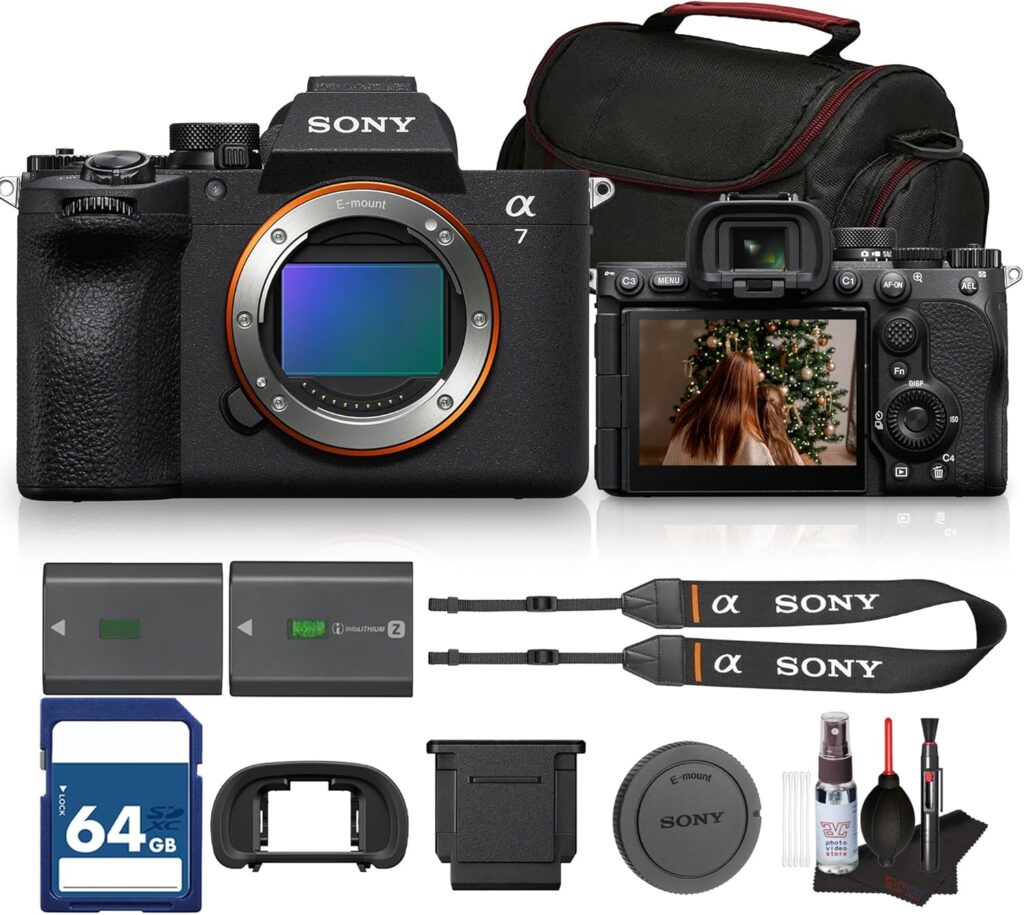
Sony A7 V Overview
The Sony Alpha 7 V is built for photographers who want one camera to cover portraits, events, travel, wildlife, commercial work, and serious video without stepping all the way into a specialized flagship body.
Its 33MP sensor gives photographers more resolution than the Canon R6 Mark II’s 24.2MP sensor. More pixels can be particularly useful for cropping wildlife photographs, producing larger prints, and retaining detail during commercial editing.
Sony also combines that sensor with faster readout and its BIONZ XR2 processing system.
For action, the A7 V can shoot at up to 30fps electronically with blackout-free viewing. Its autofocus system supports a wide range of recognized subjects, including people, animals, birds, insects, cars, trains, and aircraft.
Video shooters get 4K recording up to 120p, although the highest frame rate requires an APS-C/Super 35 crop.
Sony also includes a full-size HDMI connection, two USB-C ports, CFexpress Type A support, and newer wireless connectivity. These features can matter in professional hybrid workflows.
The biggest downside is cost. This is clearly a premium all-rounder rather than an aggressively priced enthusiast camera.
Check Sony A7 V Price on Amazon
Canon R6 Mark II Overview
The Canon EOS R6 Mark II remains a remarkably competitive full-frame camera despite being older than the Sony A7 V.
Its 24.2MP resolution is lower, but resolution is only one part of camera performance. The R6 Mark II can shoot at up to 40fps using its electronic shutter and 12fps with its mechanical shutter, giving sports, wildlife, and event photographers impressive speed.
Canon’s Dual Pixel CMOS AF II covers nearly the entire usable frame in automatic operation and provides excellent subject tracking for people, animals, and vehicles.
Video is another strength. The R6 Mark II can create full-width 4K60 footage oversampled from 6K sensor data. It also supports external RAW video with compatible equipment.
The Canon’s physical interface and handling are another major selling point. Its larger grip and direct controls make it comfortable for photographers coming from DSLRs or other traditional camera systems.
The most important advantage, however, is value. The R6 Mark II delivers high-end performance at a substantially lower cost than the Sony A7 V in many current listings.

Check Canon R6 Mark II Price on Amazon
Sony A7 V vs Canon R6 Mark II Design & Build Quality
Sony’s body is narrower and slightly shorter, while Canon is marginally lighter.
Ready to shoot with a battery and memory card, Sony weighs approximately 695g compared with Canon’s roughly 670g.
Sony offers the more versatile rear-screen mechanism, and its full-size HDMI port is preferable for filmmakers who regularly attach external monitors or recorders.
Canon’s larger grip and control layout, however, can feel more natural with large telephoto or fast-aperture lenses.
Because complete chassis-material specifications are not directly comparable in the manufacturer information reviewed, it would be misleading to declare one body more durable based only on material claims.
Winner: Canon EOS R6 Mark II
Sony A7 V vs Canon R6 Mark II Display Comparison
Sony has the advantage on the rear display.
Its 3.2-inch screen contains approximately 2.1 million dots, while Canon uses a 3.0-inch display with approximately 1.62 million dots.
The electronic viewfinders are much closer. Both sit around 3.69 million dots, although Sony provides slightly higher magnification.
Neither manufacturer publishes easily comparable smartphone-style brightness ratings in nits, so it would be misleading to claim that one is definitively better outdoors without controlled testing.
Winner: Sony Alpha 7 V
Why: The larger, higher-resolution rear display gives the Sony an advantage for reviewing images, checking focus, navigating menus, and recording video from unusual angles.
Sony A7 V vs Canon R6 Mark II Performance
For cameras, performance is more about autofocus, sensor readout, burst shooting, responsiveness, and memory-card speed than PC-style benchmarks.
Canon wins the headline frame-rate contest with up to 40fps electronic shooting compared with Sony’s 30fps.
However, Sony’s partially stacked sensor is designed for faster readout and supports blackout-free 30fps shooting with autofocus and auto-exposure tracking.
Canon’s 40fps electronic mode remains valuable when capturing extremely brief moments, such as a bird taking flight or a decisive moment in sports.
Sony counters with higher 33MP resolution, CFexpress Type A support, newer processing, sophisticated recognition, and more professional connectivity.
There are no relevant gaming or conventional multitasking benchmarks for either camera.
Winner: Sony Alpha 7 V
Why: Canon is faster in maximum frames per second, but Sony’s overall combination of sensor architecture, resolution, fast media, autofocus, and processing gives it a broader performance advantage.
Sony A7 V vs Canon R6 Mark II Camera Performance
Both cameras can deliver professional results, but their strengths are slightly different.
Sony emphasizes higher resolution, advanced subject recognition, and hybrid shooting flexibility.
Canon emphasizes speed, ergonomics, dependable autofocus, and efficient full-width 4K recording.
Image Quality and Resolution
Sony’s 33MP sensor gives it roughly 36% more pixels than Canon’s 24.2MP sensor.
That does not automatically make every photograph better, but it does provide more room for cropping and large output.
Wildlife photographers, landscape shooters, and commercial photographers who crop frequently may appreciate the extra resolution.
Canon’s 24.2MP files are still more than sufficient for weddings, portraits, events, online publishing, and substantial prints.
They are also smaller and easier to store, transfer, and process in high-volume workflows.
Winner: Sony Alpha 7 V
Why: Sony’s additional resolution provides more cropping flexibility and fine detail.
Check Sony A7 V Price on Amazon
Check Canon R6 Mark II Price on Amazon
Autofocus Performance
Sony provides up to 759 phase-detection points and automatically recognizes several subject categories.
These include humans, animals, birds, insects, cars, trains, and aircraft.
Canon’s Dual Pixel CMOS AF II also provides broad frame coverage and excellent tracking for people, animals, and vehicles.
For typical portraits, events, sports, pets, and wildlife, both are highly capable.
However, Sony’s newer recognition architecture covers a broader range of subject types and gives photographers more automated subject-selection flexibility.
Winner: Sony Alpha 7 V
Why: Sony offers the broader and newer subject-recognition system.
Video Performance
Canon’s major advantage is straightforward: its 4K60 mode can use the full sensor width and is oversampled from higher-resolution sensor data.
That produces an attractive combination of detail and full-frame field of view.
Sony goes further in slow motion by offering 4K120.
However, 4K120 on the Sony uses an APS-C/Super 35 crop. This means wide-angle lenses become less wide in that mode.
Sony also has a practical workflow advantage thanks to its full-size HDMI port rather than Canon’s smaller micro-HDMI connection.
Winner: Sony Alpha 7 V
Why: Sony wins for 4K120 capability and stronger physical connectivity.
However, filmmakers who prioritize uncropped full-width 4K60 may prefer Canon.
Sony A7 V vs Canon R6 Mark II Battery Life
Sony uses the NP-FZ100 battery and provides a strong manufacturer battery rating.
The A7 V is rated for approximately 630 images using the electronic viewfinder and around 750 using the rear LCD under standardized testing.
Canon’s R6 Mark II can also provide strong endurance depending on display mode, power-saving settings, autofocus use, wireless connectivity, and shooting style.
Real-world battery life can vary dramatically with video recording, continuous autofocus, burst shooting, temperature, and screen brightness.
Both cameras support USB-based charging or external power with compatible equipment.
Winner: Sony Alpha 7 V
Why: Sony’s published EVF endurance is particularly strong and provides more confidence for long shooting sessions.
Sony A7 V vs Canon R6 Mark II Sound Quality & Audio
Both cameras include built-in microphones and support external microphones and headphones.
For professional video production, external microphones matter much more than built-in microphone specifications.
Sony also supports digital audio through its Multi Interface Shoe ecosystem and provides a workflow aimed at hybrid video production.
Canon offers the essential microphone and headphone connections needed for interviews, events, YouTube production, and professional video work.
Without controlled recordings, it would be inappropriate to claim that one camera’s built-in microphones objectively sound better.
Winner: Sony Alpha 7 V
Why: Sony’s advantage comes from broader production connectivity rather than a claim that its built-in microphone automatically sounds better.
Sony A7 V vs Canon R6 Mark II Software & Updates
Sony supports the A7 V through its current creator-focused ecosystem, including applications for transferring images, remotely controlling the camera, monitoring video, and managing professional workflows.
Its newer platform also benefits from newer networking and connectivity hardware.
Canon also provides a mature camera software ecosystem with smartphone connectivity, remote shooting, wireless image transfer, and desktop applications.
Neither camera should be judged like a smartphone based on a promised number of major operating-system updates. Camera firmware works differently, and manufacturers generally release updates to improve stability, compatibility, or add selected features.
Winner: Sony Alpha 7 V
Why: Sony’s newer connectivity platform and creator-oriented ecosystem give it a slight advantage for hybrid workflows.
Sony A7 V vs Canon R6 Mark II Ease of Use
A camera can have outstanding specifications and still slow a photographer down if its controls feel complicated.
Canon’s R6 Mark II emphasizes direct photographic controls and a substantial grip.
That makes it especially attractive to photographers moving from a DSLR or another traditional camera body.
Sony gives experienced users extensive customization and a large number of advanced functions.
The tradeoff is that new owners may spend more time configuring menus, buttons, autofocus settings, and video options.
Both cameras provide touchscreen operation, subject-detection autofocus, and automatic exposure tools that simplify everyday use.
Winner: Canon EOS R6 Mark II
Why: Canon’s handling and control layout make advanced photography easier to approach without sacrificing serious capability.
Sony A7 V vs Canon R6 Mark II Value for Money
This is where Canon makes its strongest argument.
The Sony Alpha 7 V is technologically newer and the more complete camera overall, but it carries a significant premium.
For considerably less money, Canon still provides 40fps electronic shooting, dual UHS-II SD slots, strong autofocus, in-body stabilization, and full-width oversampled 4K60.
Those are not minor features. They are capabilities that can handle professional photography and video assignments.
Sony’s premium becomes easier to justify if you specifically need its 33MP files, partially stacked sensor behavior, 4K120, sophisticated subject recognition, CFexpress Type A support, full-size HDMI, or newer connectivity.
If you do not need those features, Canon leaves considerably more of your budget available for lenses.
And in many cases, a better lens can improve your photography more than upgrading from one already excellent camera body to another.
Winner: Canon EOS R6 Mark II
Why: It preserves most of the capabilities serious hybrid shooters care about while costing substantially less in many current listings.
Sony A7 V vs Canon R6 Mark II Ratings
These are editorial scores based on verified specifications, feature differences, intended use, and overall positioning. They are not claims of personal laboratory testing.
| Category | Sony Alpha 7 V | Canon EOS R6 Mark II |
| Design | 9.0/10 | 9.3/10 |
| Display | 9.3/10 | 8.8/10 |
| Performance | 9.5/10 | 9.2/10 |
| Camera | 9.4/10 | 9.1/10 |
| Battery | 9.2/10 | 8.9/10 |
| Software | 9.2/10 | 8.8/10 |
| Build Quality | 9.2/10 | 9.2/10 |
| Value | 8.6/10 | 9.4/10 |
| Overall | 9.2/10 | 9.1/10 |
Check Sony A7 V Price on Amazon
Check Canon R6 Mark II Price on Amazon
Sony A7 V vs Canon R6 Mark II Pros & Cons
Sony A7 V Pros
33MP full-frame partially stacked sensor
Excellent cropping flexibility
Blackout-free electronic shooting up to 30fps
Broad AI-assisted subject recognition
4K120 recording
CFexpress Type A support
Full-size HDMI
Dual USB-C ports
Newer wireless connectivity
Strong battery rating
Larger, higher-resolution rear display
Sony A7 V Cons
- Significantly more expensive
- 4K120 requires an APS-C/Super 35 crop
- 30fps maximum burst is slower than Canon’s 40fps headline rate
- Advanced settings can require more learning
- CFexpress Type A cards can add to system cost
Canon R6 Mark II Pros
- Up to 40fps electronic shooting
- 12fps mechanical burst
- Excellent Dual Pixel CMOS AF II
- Full-width oversampled 4K60
- Strong image stabilization
- Comfortable controls and handling
- Dual UHS-II SD card slots
- Strong hybrid photo and video performance
- Excellent value relative to Sony
Canon R6 Mark II Cons
- Lower 24.2MP resolution
- No 4K120 recording
- Micro-HDMI is less robust for rigged video workflows
- No CFexpress card support
- Older generation platform
- Less cropping flexibility than the Sony
Who Should Buy the Sony A7 V?
The Sony A7 V is best suited to buyers who want a premium hybrid camera and are willing to pay extra for newer technology.
Students
It makes sense for advanced photography, filmmaking, or media students who expect to move into professional work.
For someone simply learning photography, however, it is more camera than most beginners need.
Casual Users
The A7 V is probably unnecessary for casual users.
A less expensive full-frame or APS-C camera can produce excellent results without the same financial commitment.
Travelers
Serious travel photographers may appreciate Sony’s 33MP resolution, advanced autofocus, and hybrid video tools.
Lens choice will still have a large impact on the total weight of the travel kit.
Budget Buyers
The Sony is not the better choice for shoppers trying to maximize value.
Professionals
This is where the A7 V makes the most sense.
Event photographers, commercial shooters, wildlife photographers, hybrid creators, and filmmakers can benefit from its higher resolution, fast sensor architecture, advanced autofocus, professional connectivity, and 4K120 capability.
Check Sony A7 V Price on Amazon
Check Canon R6 Mark II Price on Amazon
Who Should Buy the Canon R6 Mark II?
The Canon R6 Mark II is an excellent choice for photographers who want high-end performance without paying for every newer feature available on the Sony.
Content Creators
Full-width 4K60, strong autofocus, an articulating screen, and external audio support make the R6 Mark II a highly capable creator body.
Business Users
Companies producing interviews, product photographs, training videos, events, or social media content can get professional-level output without paying the Sony premium.
Power Users
The 40fps electronic burst, in-body stabilization, autofocus performance, and dual memory-card slots give experienced photographers plenty of capability.
Enthusiasts
This may be the Canon’s sweet spot.
Photographers who want a serious full-frame body but would rather invest the remaining budget in RF lenses should give the R6 Mark II close consideration.
Sports and Event Photographers
The 40fps maximum electronic burst can be particularly helpful for capturing fast and unpredictable action.
Sony A7 V vs Canon R6 Mark II FAQs
Is the Sony A7 V Better Than the Canon R6 Mark II?
Overall, yes—but not by enough to make the Canon a bad choice.
Sony offers 33MP resolution, a newer partially stacked sensor, advanced subject recognition, CFexpress Type A support, 4K120, and professional connectivity.
Canon counters with 40fps electronic shooting, excellent handling, full-width 4K60, and significantly stronger value.
Sony is the better technical all-rounder, while Canon may be the smarter purchase for many photographers.
Which Camera Has Better Autofocus?
Both have highly capable autofocus systems.
Sony provides up to 759 phase-detection points and recognizes humans, animals, birds, insects, cars, trains, and aircraft.
Canon’s Dual Pixel CMOS AF II provides broad frame coverage and excellent subject tracking.
Sony gets the edge because its newer system recognizes a broader variety of subjects automatically.
Which Is Better for Sports and Wildlife Photography?
It depends on your priorities.
Canon reaches up to 40fps with its electronic shutter, giving it an advantage when maximum frame rate matters.
Sony reaches 30fps but combines that speed with higher 33MP resolution, blackout-free viewing, and more cropping flexibility.
Choose Canon for maximum headline burst speed.
Choose Sony for the stronger balance of speed, resolution, and subject recognition.
Which Camera Is Better for Video?
Sony is more versatile if you want 4K120 slow motion, a full-size HDMI port, and advanced hybrid tools.
The main limitation is that Sony’s 4K120 mode uses an APS-C/Super 35 crop.
Canon cannot record 4K120, but its full-width 4K60 is oversampled and keeps the full-frame field of view.
For high-frame-rate 4K, Sony wins.
For straightforward full-width 4K60, Canon is extremely competitive.
Which Camera Has Better Battery Life?
Sony has the stronger published EVF battery rating.
The A7 V is rated for approximately 630 photographs through the viewfinder and around 750 using the LCD under standardized conditions.
Real-world battery performance varies with video recording, burst shooting, autofocus, temperature, wireless connectivity, and screen brightness.
Both cameras benefit from carrying at least one spare battery for long professional shoots.
Is 24.2MP Enough on the Canon R6 Mark II?
Yes.
A 24.2MP full-frame sensor provides enough resolution for weddings, events, portraits, travel, web publishing, commercial work, and substantial prints.
Sony’s 33MP resolution becomes more valuable when you regularly crop heavily, photograph distant wildlife, or need additional resolution for large commercial output.
Do Both Cameras Have Image Stabilization?
Yes.
Both cameras include in-body sensor-shift stabilization.
Stabilization effectiveness depends on the lens, focal length, shooting technique, and conditions.
It can help with handheld low-light photography and smoother handheld video, but it does not completely replace a tripod or gimbal when those tools are appropriate.
Is the Sony A7 V Worth Paying More For?
It can be.
The premium makes the most sense for photographers and creators who will actually use the 33MP resolution, partially stacked sensor, 4K120, advanced recognition, CFexpress support, full-size HDMI, or newer connectivity.
If your work mostly involves portraits, events, travel, general photography, and 4K60 video, the Canon R6 Mark II can deliver tremendous capability while leaving more money available for lenses and accessories.
Sony A7 V vs Canon R6 Mark II: Final Verdict
In the Sony A7 V vs Canon R6 Mark II comparison, Sony wins on overall technology while Canon wins on value.
The Sony Alpha 7 V is the better all-around camera for demanding hybrid users.
Its 33MP partially stacked sensor offers more cropping freedom, its 30fps blackout-free shooting is extremely fast, its autofocus recognizes a wide variety of subjects, and its 4K120 mode expands creative video options.
The larger display, CFexpress Type A compatibility, full-size HDMI, dual USB-C connections, and newer wireless hardware strengthen its professional credentials.
Its biggest weakness is straightforward: price.
You are paying a significant premium for capabilities that many photographers may not need on every assignment.
The Canon EOS R6 Mark II remains one of the most compelling alternatives because it does not feel like a dramatically compromised camera.
It provides 40fps electronic shooting, 12fps mechanical shooting, Dual Pixel autofocus, strong stabilization, dual SD card slots, and full-width oversampled 4K60.
For a professional or serious hybrid creator who needs Sony’s specific advantages and expects to keep the camera for years, paying more for the A7 V is justified.
For an enthusiast, event photographer, portrait shooter, or creator who wants professional-level performance while keeping more money available for lenses, the Canon EOS R6 Mark II is the better-value purchase.
The best camera is not automatically the most expensive one. It is the camera whose strengths match the photographs and videos you actually intend to create.
Check Sony A7 V Price on Amazon
Check Canon R6 Mark II Price on Amazon
