Introduction
Foldable smartphones have gradually moved beyond being experimental technology. The most useful modern foldables are not simply conventional smartphones that bend; they use the folding form factor to offer practical advantages. Motorola Razr+ 2026 review.
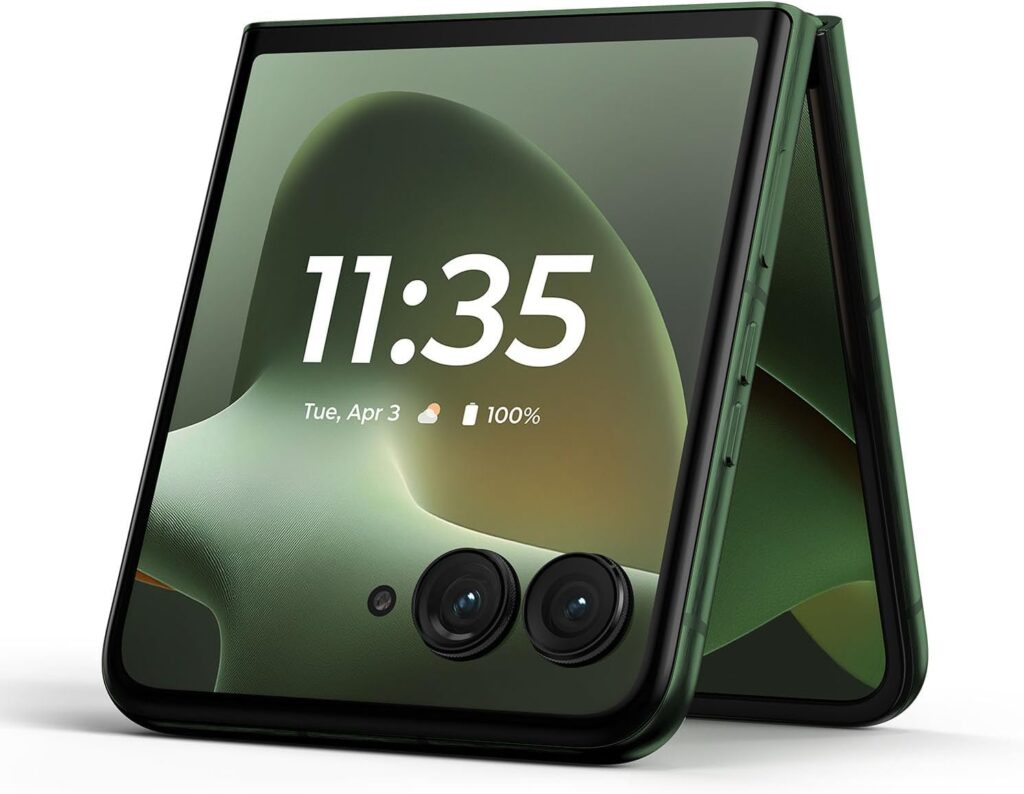
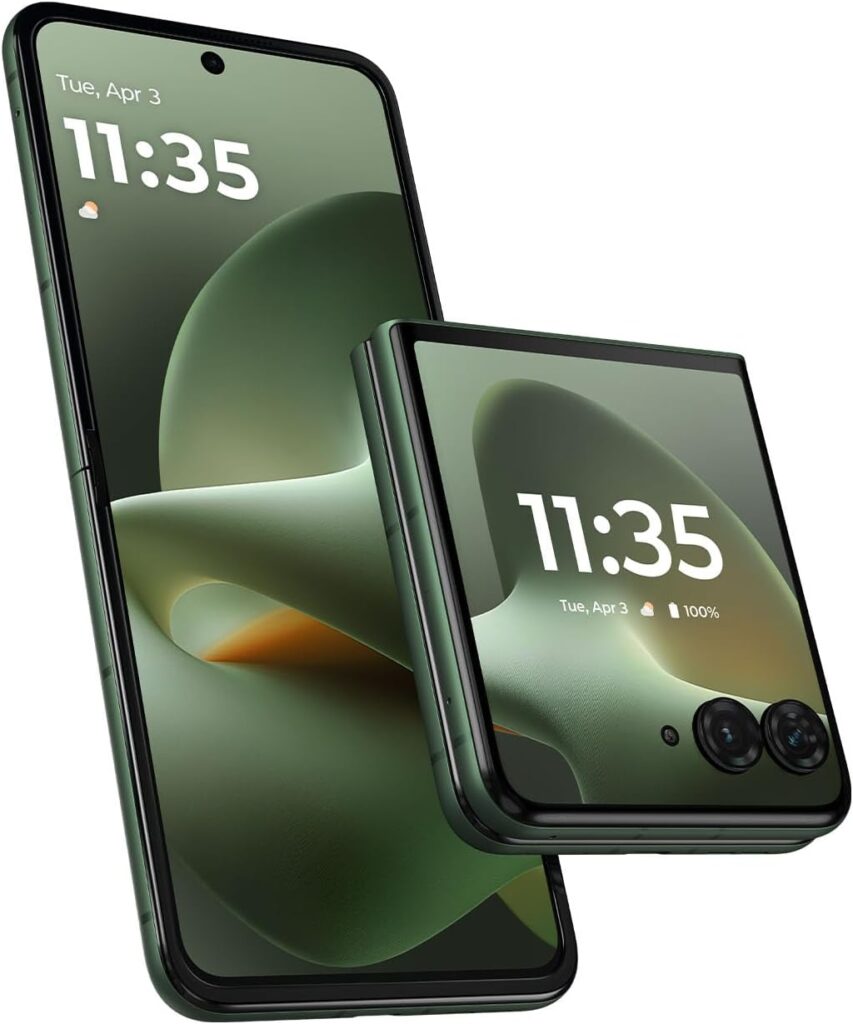
The Motorola Razr+ 2026 follows that approach. When opened, it functions like a large modern Android phone. When closed, it becomes considerably more compact while retaining access to applications and essential controls through its external display.
Motorola has positioned the Razr+ 2026 as the middle model in its 2026 Razr family. It offers more advanced hardware than the standard Razr 2026 while remaining below the Razr Ultra 2026 in performance, camera configuration, charging capability and launch price.
This review examines what Motorola and Amazon officially confirm about the device, what those specifications should mean for potential buyers and where caution is necessary because independent test results are unavailable.
Product Overview: Motorola Razr+ 2026
| Brand | Motorola |
| Operating System | Android 16 |
| Ram Memory Installed Size | 12 GB |
| CPU Model | Snapdragon 8s Gen 3 |
| CPU Speed | 3 GHz |
| Memory Storage Capacity | 12 GB |
| Screen Size | 6.9 inches |
| Resolution | 2640×1080 |
| Refresh Rate | 165 |
| Model Name | motorola razr+ – 2026 |
Key Features: Motorola Razr+ 2026 review
The most important Motorola Razr+ 2026 features include:
- A 4.0-inch external AMOLED display capable of running full applications
- A 6.9-inch LTPO AMOLED internal display with a refresh rate of up to 165Hz
- Snapdragon 8s Gen 3 mobile processor
- 12GB of physical RAM with optional RAM Boost
- 256GB of internal storage
- Dual 50MP rear cameras
- 32MP front-facing camera
- 4,500mAh battery
- 45W TurboPower wired charging
- 15W wireless charging
- 5W reverse charging
- IP48-rated water and dust protection
- Titanium-reinforced hinge construction
- Stereo speakers with Dolby Atmos
- Google Gemini and Motorola AI features
- Wi-Fi 7, 5G, NFC and USB-C connectivity
These features are based on Motorola’s official specifications and the Amazon listing. Actual application compatibility, network performance, camera results, battery endurance and charging time can vary according to configuration and use.
Full Motorola Razr+ 2026 Specifications
| Specification | Motorola Razr+ 2026 |
| Form factor | Clamshell foldable smartphone |
| Operating system at launch | Android 16 |
| Chipset | Qualcomm Snapdragon 8s Gen 3 |
| Maximum listed CPU speed | Up to 3GHz |
| GPU model | Not specified by the manufacturer |
| RAM | 12GB |
| Virtual RAM | Up to an additional 12GB through RAM Boost |
| Internal storage | 256GB |
| Expandable storage | Not specified by the manufacturer |
| Main display | 6.9-inch LTPO Extreme AMOLED |
| Main-display resolution | 1084 × 2640 pixels |
| Main-display refresh rate | Up to 165Hz |
| Main-display peak brightness | Up to 3,000 nits |
| Main-display glass | Ultra Thin Glass |
| Main-display HDR | HDR10+ certified |
| Cover display | 4.0-inch LTPS Extreme AMOLED |
| Cover-display resolution | 1272 × 1080 pixels |
| Cover-display refresh rate | Up to 165Hz |
| Cover-display peak brightness | Up to 2,400 nits |
| Cover-display protection | Corning Gorilla Glass Victus |
| Rear primary camera | 50MP, f/1.8, OIS |
| Rear secondary camera | 50MP ultrawide and macro, f/2.0, 122° field of view |
| Front camera | 32MP, f/2.4 |
| Battery capacity | 4,500mAh |
| Wired charging | Up to 45W TurboPower |
| Wireless charging | Up to 15W |
| Reverse charging | Up to 5W |
| Charger in box | A compatible high-output charger may be sold separately |
| Cellular connectivity | 5G |
| Wi-Fi | Wi-Fi 7, Wi-Fi 6E, Wi-Fi 6 and earlier supported standards |
| Bluetooth | Supported; version not specified by the manufacturer in the reviewed sources |
| NFC | Supported |
| USB | USB-C |
| SIM | Physical SIM; eSIM availability can depend on carrier |
| Audio | Stereo speakers, Dolby Atmos and Spatial Audio |
| Fingerprint sensor | Side-mounted in the power button |
| Face unlock | Not specified by the manufacturer in the reviewed sources |
| Water and dust protection | IP48 |
| Closed dimensions | 88.09 × 73.99 × 15.32mm |
| Open dimensions | Approximately 171.42 × 73.99 × 7.09mm |
| Weight | 189g |
| Official color reviewed | PANTONE Mountain View |
| Amazon ASIN | B0GS7BKHB3 |
| US launch MSRP | $1,099.99 |
The display, camera, battery, charging, dimensions and connectivity information above comes from Motorola’s official specifications and the Amazon product listing.
Design and Build Quality
The Motorola Razr+ 2026 keeps the clamshell design that Motorola reintroduced in 2019. However, this generation places a stronger emphasis on premium materials. For example, Motorola builds the hinge with titanium and protects the cover display with Gorilla Glass Victus. As a result, these upgrades improve durability compared with previous Razr models.
Additionally, the phone measures 88.1 × 74 × 15.3 mm when folded and weighs 189 g. Therefore, it fits comfortably into a pocket while still providing a solid, premium feel instead of feeling flimsy.
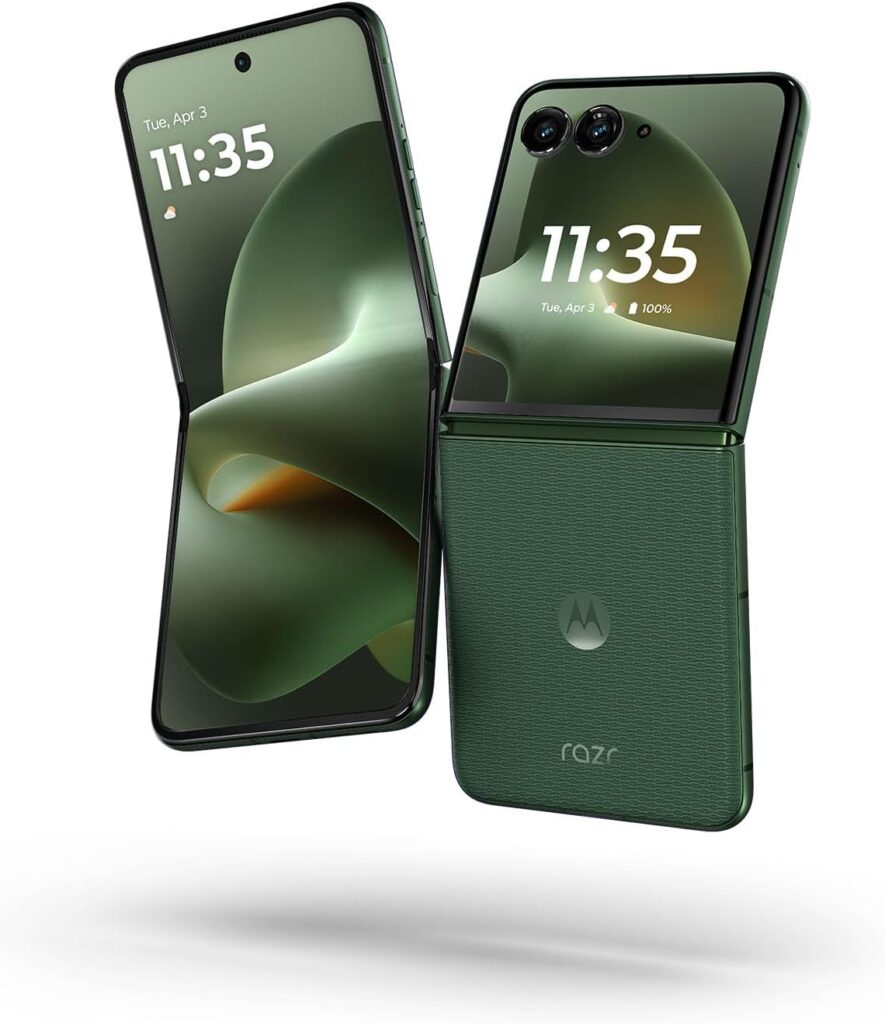
Moreover, the Pantone Mountain View finish gives the phone a distinctive appearance. The deep forest-green color and woven, jacquard-inspired texture create a fabric-like grip instead of the smooth feel of glass or plastic. Consequently, Motorola delivers a design that feels colorful, tactile, and more distinctive than many flagship foldable phones.
Furthermore, the phone carries an IP48 rating. It resists dust particles larger than 1 mm and can withstand submersion in up to 1.5 meters of water for 30 minutes. As a result, the device offers better protection against rain, accidental spills, and brief water exposure. Overall, the Motorola Razr+ 2026 combines premium materials, a compact foldable design, and improved durability in a package that stands out from earlier Razr generations.
Display Quality : Motorola Razr+ 2026
Main Display: Motorola Razr+ 2026
The internal display is a 6.9-inch LTPO Extreme AMOLED panel with a resolution of 1084 × 2640 pixels, an adaptive refresh rate of up to 165Hz and a manufacturer-rated peak brightness of up to 3,000 nits. It also supports 10-bit colour and HDR10+ certification.
On paper, these specifications are suitable for smooth scrolling, video playback, reading, multitasking and visually demanding applications. The LTPO technology allows the refresh rate to adjust according to the displayed content, which may help balance smoothness and power use. Motorola Razr+ 2026 review
The panel is also PANTONE Validated. This certification indicates that the display is designed to reproduce validated colours and skin tones within specified conditions. It does not guarantee that every application, photograph or streaming service will appear identical because software processing and source content also affect the result.
Motorola includes Water Touch support, which is intended to improve touch response when the screen or the user’s fingers are wet. Actual effectiveness was not independently tested for this review.
External Display: Motorola Razr+ 2026
The 4.0-inch LTPS Extreme AMOLED external display is one of the phone’s defining features. It has a resolution of 1272 × 1080 pixels, refreshes at up to 165Hz and reaches a claimed peak brightness of up to 2,400 nits. It is protected by Gorilla Glass Victus. Motorola Razr+ 2026 review
Unlike cover screens limited to notifications and widgets, Motorola says this display can run full Android applications. Users can reply to messages, view maps, control media, access Gemini and perform other supported actions without opening the phone. Application behaviour may differ because not every Android interface is designed for a nearly square display.
This larger cover screen is likely to be particularly useful for short interactions. It can reduce the need to unfold the device every time a notification arrives, potentially making the folding format more practical rather than purely decorative.
Processor Performance
Powering the Razr+ 2026 is Qualcomm’s Snapdragon 8s Gen 3 (model SM8635), built on a 4nm process. It’s an octa-core design with a 3.0GHz Cortex-X4 prime core, four 2.8GHz Cortex-A720 performance cores, and three 2.0GHz Cortex-A520 efficiency cores. Motorola Razr+ 2026 review
This is a step below Qualcomm’s very top-tier Snapdragon 8 Elite chip (which powers the pricier Razr Ultra 2026), but it’s still a capable mid-to-upper-tier chipset well suited to everyday multitasking, video playback, social media, and moderate gaming. Paired with 12GB of RAM, app switching and background multitasking on both displays should stay smooth in daily use. Motorola Razr+ 2026 review
GPU Performance
The exact GPU model is not specified by the manufacturer in the reviewed product information.
The Snapdragon platform includes integrated graphics, but Motorola does not publish verified gaming frame rates for the Razr+ 2026. Performance in graphically demanding games can vary according to resolution, graphics settings, temperature, game optimization and software version.
No specific FPS result should be assumed from the processor name alone.
RAM and Storage
This configuration ships with 12GB of RAM and 256GB of UFS 4.0 storage — fast, modern flash storage with no microSD expansion slot. For most users, 256GB is a comfortable amount of space for apps, photos, and 4K video, though heavy media hoarders should note there’s no way to expand storage later. Motorola Razr+ 2026 review
Camera Performance
Rear Cameras
The Razr+ 2026 has two rear cameras:
- A 50MP main camera with an f/1.8 aperture, optical image stabilization and an approximately 81.5-degree field of view
- A 50MP ultrawide camera with an f/2.0 aperture and a 122-degree field of view, which also supports macro photography
Motorola also lists PANTONE Validated colour and skin-tone processing for the camera system.
The main camera’s optical stabilization is designed to compensate for small movements during image capture and video recording. This can be beneficial in lower light or when recording handheld video, although the final result also depends on exposure, software processing and subject movement.
The ultrawide camera offers a broader field of view for landscapes, architecture and group photographs. Its macro capability provides another shooting option without requiring a separate low-resolution macro sensor.
The camera hardware appears versatile, but image quality, autofocus accuracy, dynamic range, colour consistency and low-light performance were not independently tested. No claim should be interpreted as a substitute for original camera samples.
Front Camera
The internal front-facing camera uses a 32MP sensor with an f/2.4 aperture and an approximately 80.5-degree field of view. Motorola lists pixel-binned output with an effective 1.4-micron pixel size. Optical image stabilization is not included on this camera.
A foldable phone also offers an alternative method for taking self-portraits: users can frame photographs on the cover display while using the higher-specification rear cameras.
Video Recording
Motorola’s specification information lists a default video setting of Full HD at 30 frames per second. Maximum supported resolutions, frame rates and all available recording modes were not comprehensively specified in the reviewed sources.
The stabilized primary camera and flexible hinge may be helpful for handheld or partially supported recording. The device can be positioned at different angles without a separate stand, although stability will depend on the surface and hinge position.
Verified maximum 4K or slow-motion recording specifications are not specified by the manufacturer in the reviewed information and are therefore not assumed here.
Battery Life
The Razr+ 2026 packs a 4500mAh battery, a 500mAh increase over the previous generation’s razr+ model. Motorola states this delivers more than 31 hours of battery life under its own mixed-use testing conditions, which combine active usage and standby time under optimal network conditions.
As with all manufacturer battery claims, actual results will vary significantly based on signal strength, screen brightness, refresh rate settings, and individual usage habits.
Independent, hands-on battery drain test results: Not specified by the manufacturer.
Charging Speed
Charging is one of the clearer upgrades this generation:
- 45W wired TurboPower charging — Motorola states this can deliver a full day’s power in about 11 minutes of charging
- 15W wireless charging
- 5W reverse wireless charging, useful for topping up earbuds or accessories
Note that a TurboPower-compatible charger is typically sold separately and is not guaranteed to be included in the box — check the listing for exact bundled accessories.
Gaming Performance
The Snapdragon 8s Gen 3 processor, 12GB of RAM, and a 165Hz display give this phone a promising hardware combination for Android gaming. As a result, the high-refresh-rate display can deliver smoother animations in games that support higher refresh rates, creating a more responsive gaming experience.
However, Motorola does not publish verified FPS results for individual games. Additionally, the company does not provide official information about sustained gaming performance, thermal throttling, touch latency, or battery drain during extended gaming sessions. Therefore, buyers should not rely only on the listed specifications when evaluating gaming performance.
Moreover, the folding design may distribute heat differently than a traditional single-body smartphone. For this reason, gamers who plan to play demanding titles for long periods should review independent thermal and sustained-performance tests instead of relying solely on short benchmark results. Overall, independent real-world testing provides a more accurate picture of long-term gaming performance. Motorola Razr+ 2026 review
AI Features
The Razr+ 2026 incorporates both Google and Motorola AI functionality.
Google Gemini can be accessed for conversational assistance, planning, writing help and supported multimodal interactions. Gemini Live is intended to support more natural real-time conversations and contextual assistance. Availability and features may depend on application version, account, language, country and internet connection.
Motorola also promotes moto ai features that can help users recall information, summarize selected content and retrieve previously captured details. The precise behaviour of these tools can change through software updates, and some features may require setup, permissions or a network connection.
The external display can provide access to supported AI functions without unfolding the phone, making the cover screen more useful for brief voice or text interactions.
Software and User Experience
The Motorola Razr+ 2026 launched with Android 16. Motorola generally keeps the interface recognizably close to Android while adding foldable controls, gestures, personalization tools, moto ai and Smart Connect.
Smart Connect can help users share content and extend supported phone functions across compatible computers, tablets and displays. The exact feature set depends on the connected device and software version.
The cover-screen software is central to the overall experience. Users can place shortcuts, use widgets, control media and run compatible applications. Motorola also supports animated or video-based wallpaper options on the external screen.
Software Update Support
Motorola’s current US support page states that the Razr+ 2026 launched in May 2026 with Android 16. It lists Android 17 as the next operating-system version and states that security updates are scheduled to continue until May 2030, with updates provided at least every two months. Motorola also notes that update plans and timing may change according to carrier, region and other factors.
The available official support information does not clearly guarantee the complete number of major Android upgrades beyond the listed next version. Buyers who consider long-term operating-system support a top priority should review Motorola’s current support page before ordering.
Software and User Experience
The Motorola Razr+ 2026 launches with Android 16. Additionally, Motorola keeps the interface close to the standard Android experience while adding foldable features, intuitive gestures, personalization tools, moto ai, and Smart Connect. As a result, users receive a familiar interface with extra features designed specifically for a foldable phone.
Furthermore, Smart Connect helps users share content and extend supported phone functions across compatible computers, tablets, and displays. However, the available features depend on the connected device and its software version. Therefore, users may notice different capabilities when connecting different devices.
Moreover, the cover-screen software plays a central role in the overall user experience. Users can place shortcuts, add widgets, control media playback, and run compatible applications directly from the external display. Additionally, Motorola supports animated and video-based wallpapers for the cover screen, allowing users to personalize the phone even further. Overall, the software combines familiar Android features with foldable-specific tools to create a more convenient and customizable experience.
Software Update Support
Motorola’s current US support page states that the Razr+ 2026 launched in May 2026 with Android 16. It lists Android 17 as the next operating-system version and states that security updates are scheduled to continue until May 2030, with updates provided at least every two months. Motorola also notes that update plans and timing may change according to carrier, region and other factors. Motorola Razr+ 2026 review
The available official support information does not clearly guarantee the complete number of major Android upgrades beyond the listed next version. Buyers who consider long-term operating-system support a top priority should review Motorola’s current support page before ordering.
Connectivity (5G, Wi-Fi, Bluetooth, NFC, USB)
- 5G: Full sub-6GHz 5G support (SA/NSA), plus complete 4G/3G/2G band coverage for US carriers
- Wi-Fi: Wi-Fi 7, tri-band support for faster, more stable connections on compatible routers
- Bluetooth: Bluetooth 5.4 with A2DP and LE support
- NFC: Yes, supports contactless payments and file sharing
- USB: USB Type-C 2.0 (data transfer speeds are on the slower USB 2.0 standard rather than USB 3.x)
- SIM: Nano-SIM plus eSIM support
There is no 3.5mm headphone jack and no FM radio, both increasingly standard omissions on modern flagship-tier phones.
Audio & Speakers
The Razr+ 2026 includes stereo speakers with Dolby Atmos support, tuned for fuller sound during media playback and calls. Since there’s no headphone jack, wired audio requires a USB-C adapter or USB-C headphones, while wireless audio relies on Bluetooth 5.4.
Security Features
Motorola integrates a fingerprint reader into the side-mounted power button. As a result, users can unlock the phone quickly whether they keep it folded or unfold it. Additionally, the Amazon listing confirms fingerprint recognition as one of the device’s security features.
However, the reviewed manufacturer documentation does not clearly identify face unlock support. Therefore, the manufacturer currently lists this feature as unspecified. Buyers who require face unlock should verify the feature before making a purchase.
Moreover, Android provides several built-in security features, including screen-lock controls, application permissions, Google Play Protect, and account protection options. However, the availability of these features may vary depending on the Android version and account configuration. Overall, the Motorola Razr+ 2026 offers a strong security foundation through fingerprint authentication and Android’s integrated security tools while leaving face unlock support unconfirmed.
Performance Summary
| Area | Specification-based assessment |
| Everyday performance | Strong hardware for premium Android use |
| Multitasking | 12GB RAM should support demanding daily use |
| Gaming | Promising specifications, but no verified FPS data |
| Main display | High-resolution 165Hz AMOLED with strong claimed brightness |
| Cover display | One of the phone’s most useful and distinctive features |
| Camera system | Versatile dual 50MP setup; real image quality requires testing |
| Battery | Large capacity for a compact flip design, with manufacturer claim exceeding 31 hours |
| Charging | Good combination of wired, wireless and reverse charging |
| Software | Android 16 with Gemini, moto ai and foldable-specific controls |
| Durability | IP48 rating, titanium hinge and Victus cover glass |
| Long-term support | Security updates currently listed through May 2030 |
Pros
- Large, genuinely useful 4.0″ external display that runs full apps
- Smooth 165Hz refresh rate on both the internal and external displays
- Titanium hinge and IP48 water/dust resistance
- Fast 45W wired charging with 15W wireless support
- Flexible dual 50MP camera system with Macro Vision and Flex View selfie mode
- Clean, close-to-stock Android software with strong AI feature integration
- Distinctive, premium Pantone Mountain View finish with a textured back panel
Cons
- Snapdragon 8s Gen 3 is not a top-tier chipset — the Razr Ultra 2026 offers noticeably more power
- No microSD expansion; 256GB is fixed for this configuration
- No 3.5mm headphone jack or FM radio
- USB 2.0 speeds limit fast wired file transfers
- Charger typically sold separately
Who Should Buy the Motorola Razr+ 2026?
The Motorola Razr+ 2026 is best suited to:
- Buyers who specifically want a premium clamshell foldable
- Users who value a functional cover screen rather than a small notification panel
- People who want a large display in a phone that becomes compact when folded
- Buyers interested in rear-camera selfies and hands-free content creation
- Users who want both wired and wireless charging
- Shoppers who prefer Motorola’s Android interface and foldable controls
- Buyers who like distinctive colours and textured finishes
- Users who need an unlocked US-market smartphone with broad carrier compatibility
Who Should Avoid It?
The Razr+ 2026 may not be the best choice for:
- Buyers looking for the lowest cost per specification
- Users who do not care about folding functionality
- People who prefer a conventional rigid display
- Buyers who need confirmed expandable storage
- Professional mobile gamers requiring verified sustained FPS and thermal results
- Users who need a clearly guaranteed long-term major Android-upgrade policy
- Buyers who want Motorola’s most powerful 2026 processor
- Users who frequently expose their phone to sand, construction dust or harsh environments
Frequently Asked Questions
1. Is the Motorola Razr+ 2026 an Android phone?
Yes. The Motorola Razr+ 2026 is a foldable Android smartphone that launched with Android 16.
2. Is the Motorola Razr+ 2026 unlocked?
The Amazon model is listed as an unlocked smartphone made for the US market. It is advertised as compatible with major US carriers, but buyers should confirm individual network support before ordering.
3. What processor does the Motorola Razr+ 2026 use?
It uses the Qualcomm Snapdragon 8s Gen 3 mobile platform with a listed CPU speed of up to 3GHz.
4. How much RAM and storage does it have?
The reviewed configuration includes 12GB of physical RAM and 256GB of internal storage. Motorola’s RAM Boost can allocate up to an additional 12GB of storage as virtual memory.
5. Can the Razr+ 2026 run apps on the cover display?
Yes. Motorola says the 4.0-inch external display can run full applications, allowing users to access supported apps, messages, maps and controls while the phone is closed.
6. What cameras does the Razr+ 2026 have?
It has a 50MP stabilized main camera, a 50MP ultrawide camera with macro capability and a 32MP internal front camera.
7. Does the Motorola Razr+ 2026 support wireless charging?
Yes. It supports wireless charging at up to 15W and reverse charging at up to 5W.
8. How fast is wired charging?
The phone supports up to 45W TurboPower wired charging. Motorola advertises power for the day from around 11 minutes under controlled conditions, but this is not a full-charge claim.
9. How long does the battery last?
Motorola claims more than 31 hours of battery life under its internal testing method. Actual battery life depends on usage, connectivity, display settings and other conditions.
10. Is the Motorola Razr+ 2026 waterproof?
It has an IP48 water and dust-resistance rating. Motorola describes water protection up to 1.5 metres under controlled conditions, but resistance can decrease over time and should not be treated as permanent waterproofing.
11. Does the Motorola Razr+ 2026 support 5G?
Yes. The Amazon listing confirms 5G cellular connectivity. Network availability and speed depend on the carrier, location and service plan.
12. Does it support Wi-Fi 7?
Yes. Motorola lists support for Wi-Fi 7 as well as Wi-Fi 6E, Wi-Fi 6 and earlier standards.
13. How long will the Razr+ 2026 receive security updates?
Motorola’s current US support page lists security updates through May 2030, with updates scheduled at least every two months. Update schedules remain subject to change.
14. Is the Motorola Razr+ 2026 good for gaming?
Its Snapdragon 8s Gen 3 processor, 12GB RAM and 165Hz display provide promising gaming specifications. However, Motorola does not publish verified game-specific FPS, sustained-performance or thermal results.
15. Is the Motorola Razr+ 2026 worth buying?
It is worth considering for buyers who value a compact folding design, a highly functional external screen, dual 50MP cameras and wireless charging. Buyers focused mainly on maximum performance or value should also compare the standard Razr 2026, Razr Ultra 2026 and conventional non-folding phones.
Final Verdict
The Motorola Razr+ 2026 succeeds by focusing on what actually matters in daily foldable use: a cover screen big enough to be genuinely functional, a fast-refreshing internal display, dependable charging speeds, and a durable, good-looking build. It doesn’t try to be the fastest phone on the market, and it doesn’t need to be — for most buyers, it hits a well-balanced sweet spot between Motorola’s more affordable razr 2026 and its top-tier razr Ultra 2026.
If compact design, display quality, and everyday usability matter more to you than chart-topping benchmarks, the Razr+ 2026 is one of the more compelling foldables available this year. Motorola Razr+ 2026 review.